Class 1 Sentence Building Worksheets
Help Class 1 children build clear sentences with noun-and-verb practice, guided examples, correction prompts and exact iBloom activities.
Free printable worksheet
Free sentence building worksheet for Class 1
This two-page printable has eight jumbled sentences to put in order and two words to use in sentences of the child's own, with sample answers on page 2.
- Free PDF download
- Answer key included
- Ready to print
Free to print and use at home or in class. How to use this worksheet

Overview
Class 1 sentence building worksheets are most useful when children understand what each word is doing. A learner may know many words but still need help choosing a naming word, adding an action, arranging the words in order and finishing the sentence correctly. This guide gives parents and teachers a short routine for practising those steps without turning every correction into a long grammar lesson.

Free sentence building worksheet for Class 1
This two-page printable has eight jumbled sentences to put in order and two words to use in sentences of the child's own, with sample answers on page 2.
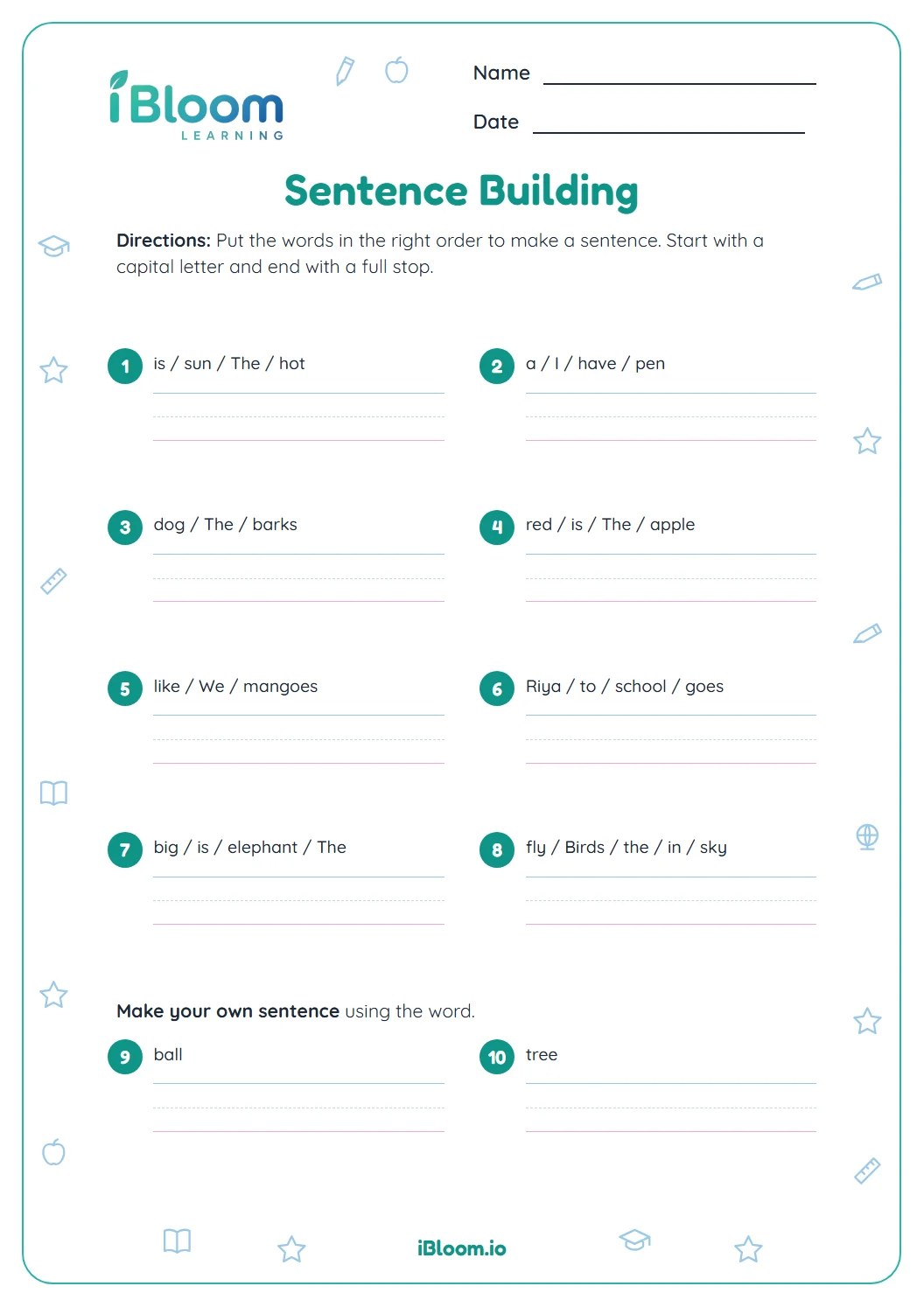
Download the free sentence building worksheet PDF
Answer key preview
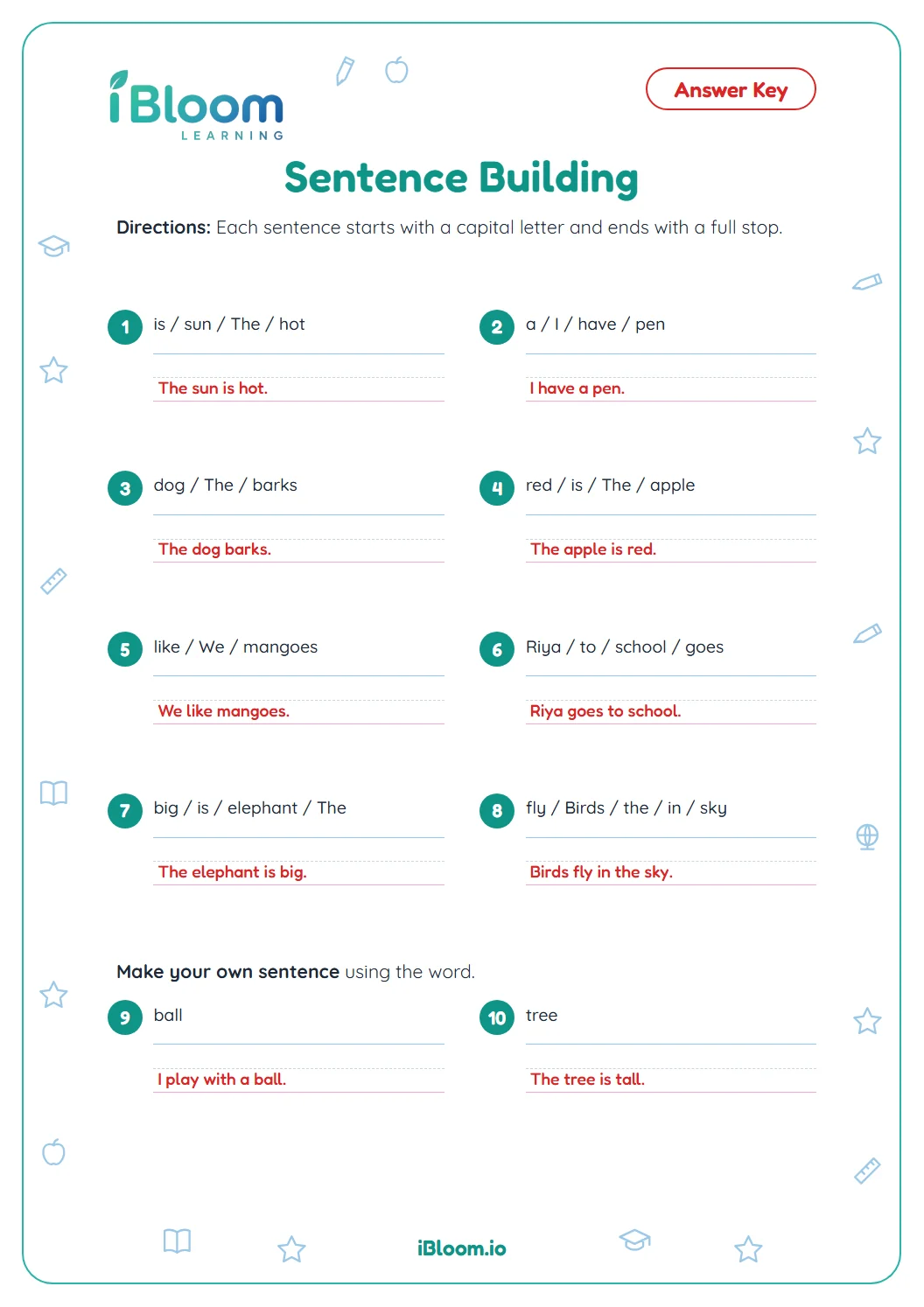
Ask your child to find the naming word first, then the doing word. The rest of the sentence usually falls into place.

Start with Exact iBloom Practice
Use the worksheet when the child is ready to arrange or complete sentences independently. Use the lesson when the child first needs a model and spoken explanation.
Keep the same target for one short session. Moving between many unrelated pages can make it harder to see whether the child has understood the sentence pattern.

What a Complete Class 1 Sentence Needs
A simple sentence expresses one complete idea. At this stage, children can check four visible features:
- It names who or what the sentence is about.
- It tells what that person, animal, place or thing does or is.
- The words appear in an order that makes sense.
- It begins with a capital letter and ends with suitable punctuation.
For example, “The puppy runs.” has a naming part, an action, sensible word order, a capital letter and a full stop. “Runs puppy the” contains useful words, but the order does not communicate the idea clearly.
Build Sentences from Nouns and Verbs
Begin with two choices instead of asking for a whole sentence immediately. Write a noun such as “bird” and ask, “What can a bird do?” The child might answer “flies,” “sings” or “hops.” Place the chosen words together, then add small words where needed:
- bird + flies becomes “The bird flies.”
- children + read becomes “The children read.”
- cat + sleeping becomes “The cat is sleeping.”
This approach shows that sentence writing is a series of decisions. The child is not expected to invent every word at once.

A Ten-Minute Sentence Building Routine
1. Read one model
Read a short sentence aloud and ask the child to point to the capital letter, the naming word, the action and the final punctuation mark.
2. Arrange mixed words
Give three to six word cards. Ask the child to find the word that should begin the sentence, arrange the remaining words and read the result aloud. Hearing the sentence often reveals an incorrect order.
3. Improve one detail
Once the basic sentence is correct, add one useful detail. “The dog runs” can become “The brown dog runs fast.” The aim is clarity, not the longest possible sentence.
4. Write and check
The child copies or writes the sentence, then uses a simple check: capital, spaces, sensible order and full stop or question mark.
Practice Examples for Adults to Model
Use familiar subjects so the language task stays manageable:
- “Riya carries a blue bag.”
- “The bus stops near school.”
- “Two ducks swim in the pond.”
- “My brother reads a comic.”
- “Where is the red ball?”
Ask one question at a time: “Who is the sentence about?”, “What is happening?” or “Which detail helps the reader picture it?” These prompts are clearer than saying only, “Make it better.”

Common Sentence Building Problems
The sentence has no action
“The small yellow kite” names something but does not yet tell a complete idea. Ask, “What does the kite do?” A possible revision is “The small yellow kite flies.”
The words are in the wrong order
Have the child read the words aloud slowly. Then locate the naming word and the action before moving the remaining words.
Every sentence begins the same way
Offer different subjects or openings rather than demanding variety without support. Picture prompts, names, places and time words can help.
Capitals and punctuation are missing
Separate composition from checking. First build the idea; then make a second pass for the capital letter, spaces and punctuation.
Support for Different Learners
For a child who is just beginning, provide complete word cards and two possible arrangements. For a child who can already make a basic sentence, ask for one precise verb or one helpful describing word. If handwriting is slowing the task, let the child arrange cards and say the sentence before writing it.
Teachers can use the same pattern in a small group: model one item, solve one together, then give each learner one independent sentence. Parents can use household objects or a family picture instead of preparing special materials.
How to Check Understanding
A child is ready to move forward when they can explain why a word belongs in a particular place, not only copy the correct answer. Ask the learner to:
- identify the naming word and action;
- repair one mixed-up sentence;
- add a meaningful detail;
- read the finished sentence aloud;
- check the beginning and ending marks independently.
If one step remains difficult, return to that step in the next session instead of adding more sentence types.
Related Class 1 Practice
After children can build a basic sentence, continue with Making Story Sentences Better. It gives a natural next step from correct sentences to clearer story details.
Frequently Asked Questions
How many sentences should a Class 1 child practise at once?
Three to five carefully discussed sentences are often more useful than a long page completed without explanation. Stop while the child can still check the work attentively.
Should children learn grammar terms first?
Simple terms such as noun and verb can help, but children also need to use the words in meaningful sentences. Pair each term with an example and an action.
What should I say when the word order is wrong?
Ask the child to read the sentence aloud, find who or what it is about, and then find the action. This guides the repair without immediately supplying the answer.
Can picture prompts help sentence writing?
Yes. A clear picture gives the child a subject, an action and possible details. Ask what is visible before asking for a written sentence.
When should we add longer sentences?
Add details after the child can consistently build a clear basic sentence. Longer writing should grow from secure structure rather than replace it.