
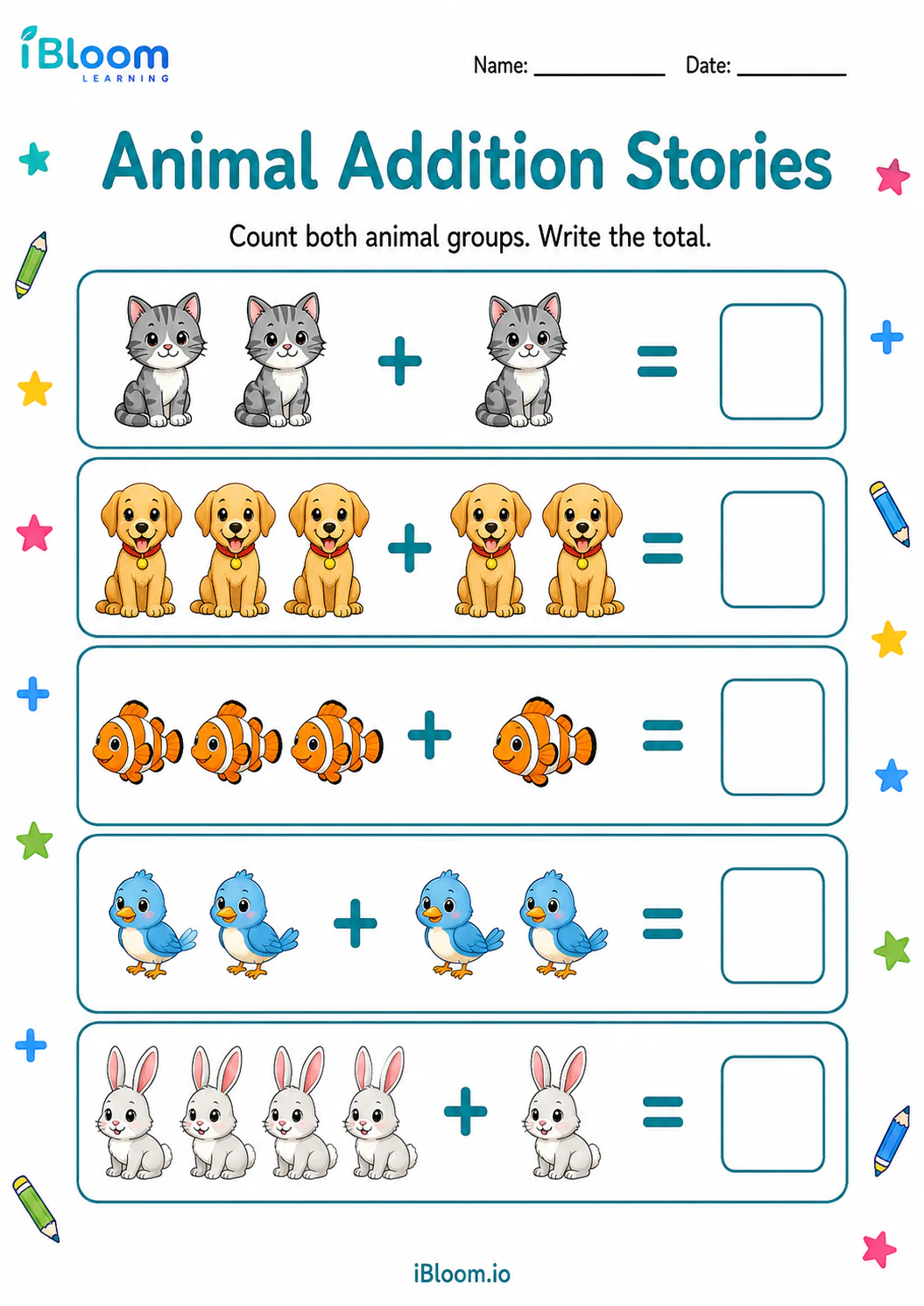
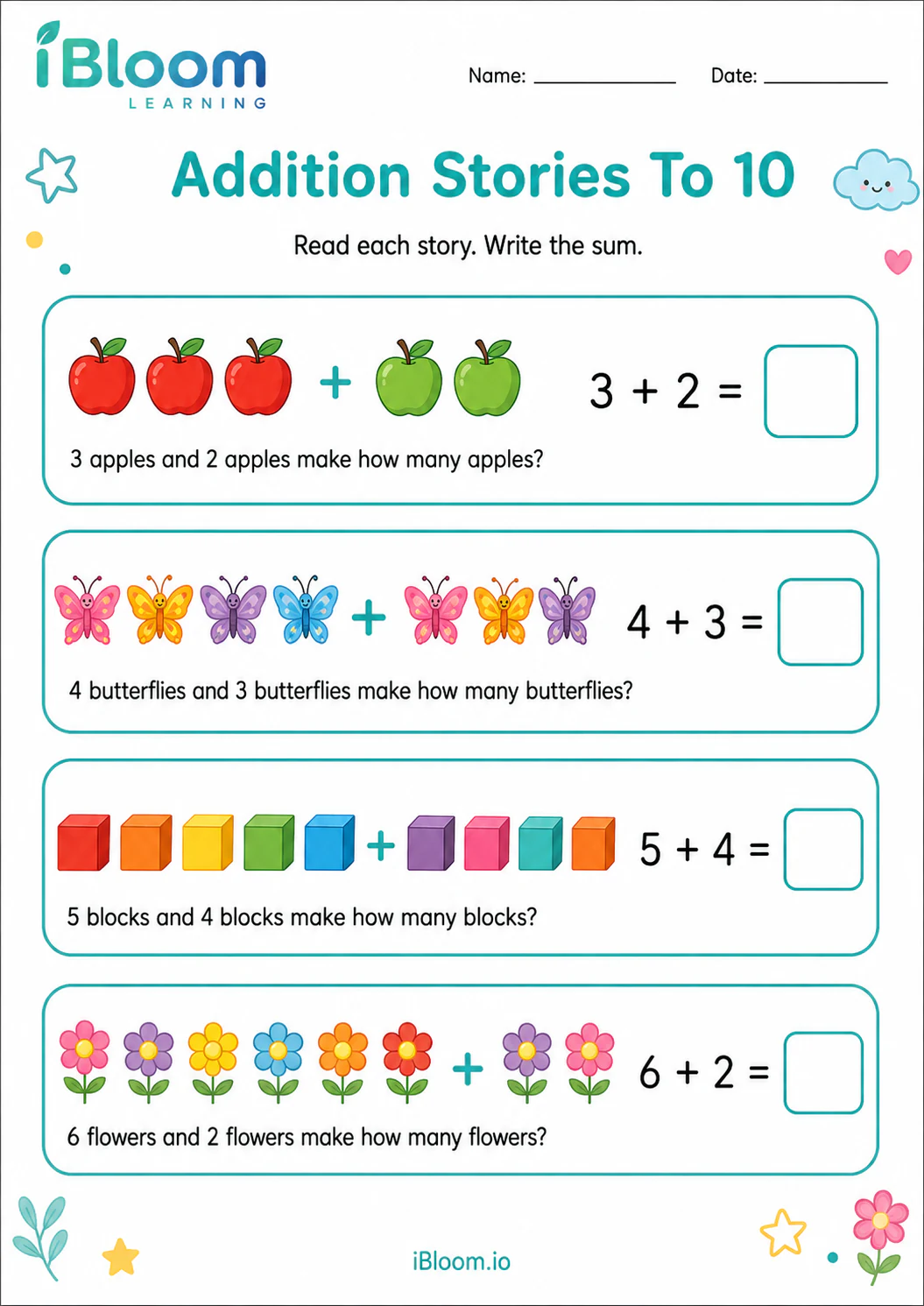
About this worksheet
This printable worksheet is for Kindergarten learners practicing addition within 5 with counters and number bonds. It offers 16 carefully sequenced questions, plus a separate answer key. It aligns with K.OA.A.1.
Aligned to K.OA.A.1
How can you find a total?
Count the counters already in the ten-frame, then add the new counters named in the question. For example, 3 counters plus 2 more makes 5.
How do the parts make a whole?
A number bond shows two parts that make one whole. If the whole is 5 and one part is 1, the missing part is 4 because 1 and 4 make 5.
How to use this worksheet
- 1Read all directions before beginning.
- 2Complete each question in order and show the requested unit or evidence.
- 3Check each response against the separate key.
Common mistakes and quick fixes
The mistake
Counting the first group again after counting on.
The fix
Say the first group’s number, then count only the added counters.
The mistake
Writing the whole as the missing number bond part.
The fix
Subtract the known part from the whole to find the other part.
The mistake
Skipping an object while counting.
The fix
Touch or move each counter once as you say one number for it.
Curriculum alignment
This worksheet practices the measurement and reasoning standard through its problems.
Represent sums with counters, pictures, number bonds, and equations.
On this sheet:
Show the official wordingHide the official wording
Represent addition and subtraction with objects, fingers, mental images, drawings, sounds (e.g., claps), acting out situations, verbal explanations, expressions, or equations.
What to practice next
Make more practice
Further reading
Questions parents and teachers ask
What does this worksheet practice?
The 16 items practice adding within 5 with ten-frame models and finding a missing part in number bonds. The drawings help children see the quantities while they count and combine. The drawings and key let an adult review each quantity with the child.
How can I help a child add the counters?
Ask the child to count the counters in the ten-frame first, then count on by the number named in the prompt. The answer key gives the total for each addition item. The drawings and key let an adult review each quantity with the child.
What is a number bond?
A number bond shows a whole and the parts that combine to make it. On this worksheet, each bond has one missing part, so learners can subtract the known part from the whole or count up to find it. The drawings and key let an adult review each quantity with the child.
How many problems are there?
There are 16 questions: eight additions using ten-frame drawings and eight missing-part number bonds. The separate key lists the answer to each item. The drawings and key let an adult review each quantity with the child. The examples name the unit so learners can see what the final answer should include.
Is an answer key included?
Yes. The key lists the totals and missing parts. For example, a bond with a whole of 5 and a known part of 1 has a missing part of 4. The drawings and key let an adult review each quantity with the child.