
About this worksheet
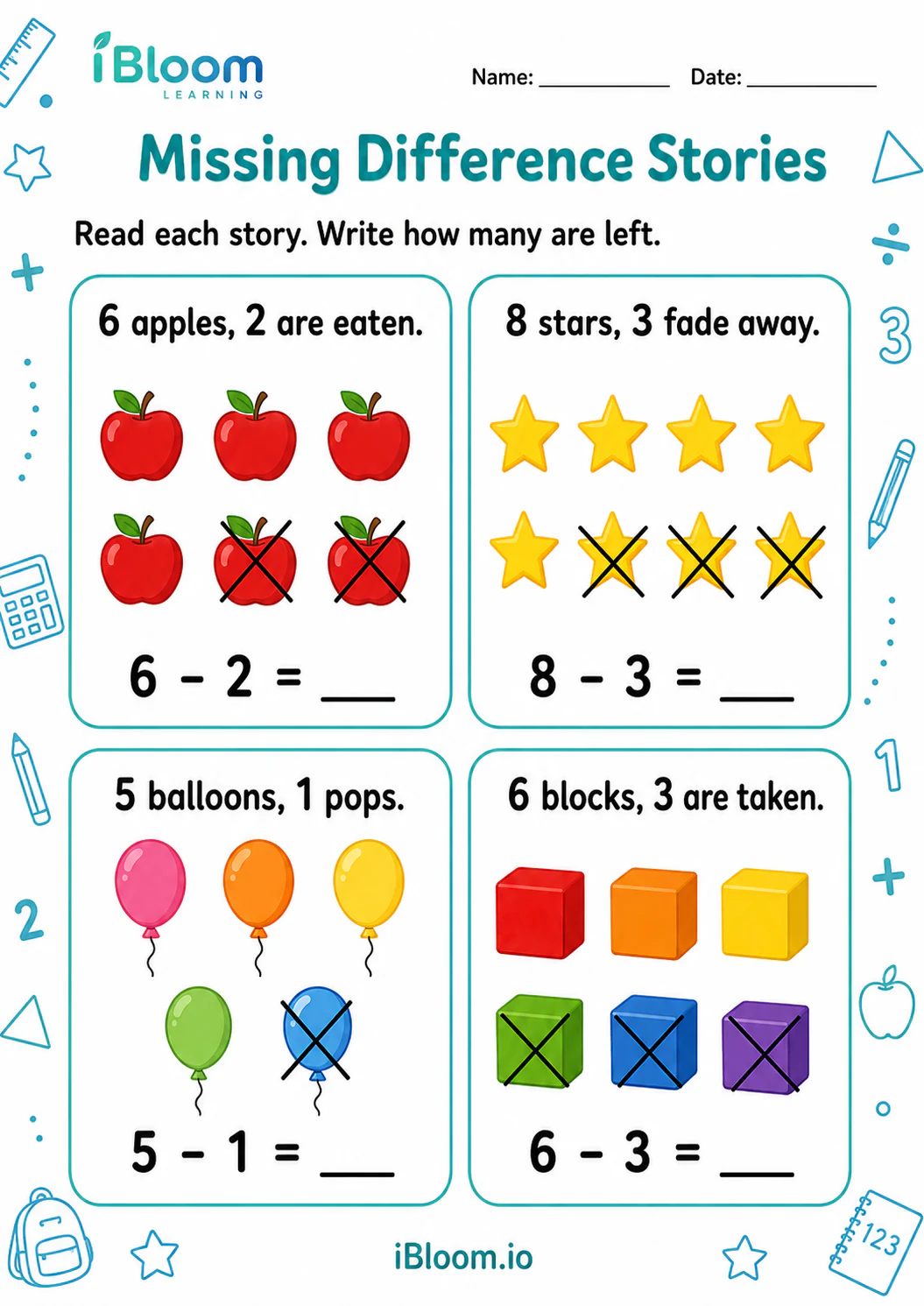
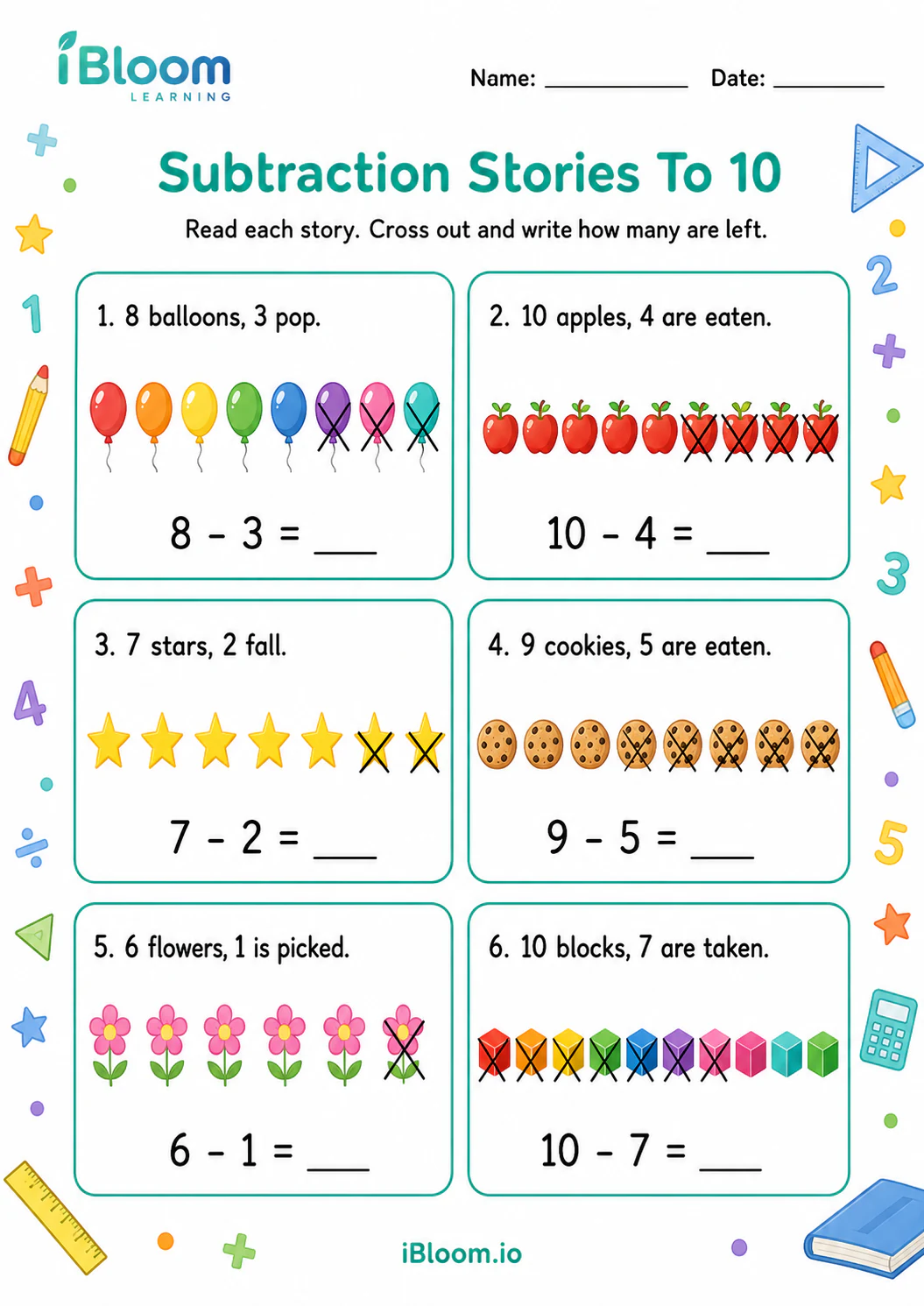
This free printable gives Kindergarten learners practice finding missing differences within 10. Six equations build fluency, five number bonds connect subtraction to part-whole thinking, and five short stories put take-away situations into words. The separate answer key supports quick checking. Learners can use objects, fingers, or drawings to find what remains, as described in K.OA.A.1.
Aligned to K.OA.A.1
How do you find a missing difference?
Think of the starting number as the whole. The number being taken away is one part; the missing difference is the other part. Count on from the number taken away or use objects to check.
- 15 − ___ = 3
- 2The missing part is 2 because 5 − 2 = 3.
How do the number bonds help?
Each number bond shows the starting whole and the amount taken away. Find the empty part, then check that both parts combine to make the whole.
How can a story become a subtraction sentence?
In a take-away story, start with the full group and remove the amount that leaves. For “6 birds sat on a fence. 2 flew away,” write 6 − 2 = 4 birds.
How to use this worksheet
- 1Read the subtraction sentence from left to right.
- 2Name the starting whole and the part taken away.
- 3Find the missing part by counting or using objects.
- 4For a story, picture the group before and after the action.
- 5Check by adding the two parts back to the whole.
Common subtraction slips
The mistake
Subtracting the starting number from the smaller number.
The fix
Begin with the whole, then take away the named part.
The mistake
Writing the number taken away as the difference.
The fix
Count what remains after taking away.
The mistake
Forgetting the story asks how many stayed.
The fix
Track the starting group and remove only the objects that leave.
Common Core alignment
Learners model take-away situations and missing parts with equations and number bonds.
Represent subtraction situations with objects, drawings, and equations.
On this sheet:
Show the official wordingHide the official wording
Represent addition and subtraction with objects, fingers, mental images, drawings, sounds (e.g., claps), acting out situations, verbal explanations, expressions, or equations.
What to practice next
Make more practice
Further reading
Questions parents and teachers ask
How does a child find the missing difference?
Keep the starting number as the whole and subtract the known part. Count what remains, or count up from the known part to the whole; the amount counted is the missing difference. The number bonds show the same relationship with a whole and two parts.
What is on the worksheet?
The worksheet has 16 questions in three sections: six missing-number equations, five number bonds, and five short take-away stories. Each section practices a different way to think about the same subtraction relationship, with answers on the separate key. The problems use numbers within 10.
Does it include an answer key?
Yes. The answer key is separate from the two worksheet pages and gives an answer for every question. A child can try the problems first, then use the key with an adult to check and explain any missed item. Review the number sentence together.
Can children use counters or fingers?
Yes. Counters, fingers, or small objects can model the starting group and the amount taken away. Then count the objects left and write that number in the blank. The number bonds offer another way to represent the parts. The picture gives a visible part-whole model.
How long does the worksheet take?
Plan for about 15 minutes, depending on how often the learner models with objects or talks through a story. It is fine to pause between the equation, number-bond, and story sections, or complete one section at a time. A short pause can help keep the work focused.