


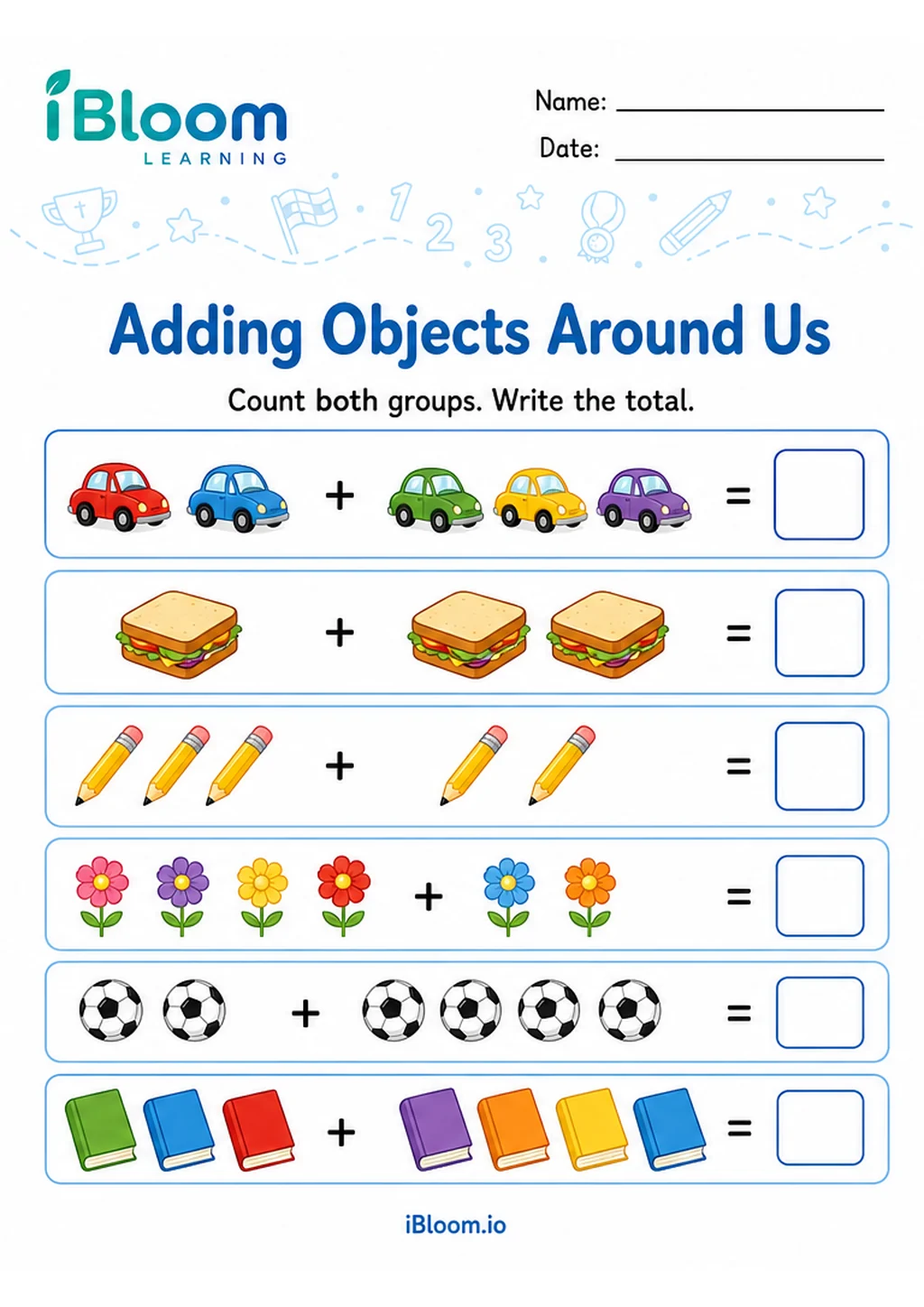
About this worksheet
This gentle preschool–kindergarten addition review brings back the old sheet’s mix of counting, choosing a total, joining groups, and adding objects to a frame. The 18 pictured questions use small groups, with totals within ten, so children can count each object as they combine groups. A separate answer key supports checking after practice.
Aligned to K.OA.A.2
What skill does this worksheet practice?
This gentle preschool–kindergarten addition review brings back the old sheet’s mix of counting, choosing a total, joining groups, and adding objects to a frame. The 18 pictured questions use small groups, with totals within ten, so children can count each object as they combine groups. A separate answer key supports checking after practice.
How can a child work through the questions?
For a joining story, count the first group, then continue with the new objects. In the final part, count the counters already in the frame and add two more.
- 1There are 2 apples. 3 more join them. How many apples are there now?
- 2Count 2, then 3 more: 3, 4, 5.
- 3Answer: 5 apples
What is included on the printable pages?
The 18 questions appear in 3 parts: count pictured groups and choose a total, solve joining stories, then add two objects to each pictured group to reach a target. The answer key lists the totals and describes the drawing task.
How to use this worksheet
- 1Read the directions together before starting.
- 2Complete the first part slowly and talk through the strategy.
- 3Work through the remaining parts, pausing to reread any confusing prompt.
- 4Use the answer key after the learner has finished.
- 5For any missed item, revisit the clues or model and try it again.
Common mistakes and quick fixes
The mistake
Rushing past an important clue in the prompt.
The fix
Reread the whole prompt and point to the detail that supports the answer.
The mistake
Giving an answer that does not match the requested form.
The fix
Check whether the item asks for a number, word, choice, or explanation.
The mistake
Changing an answer without checking the model or text.
The fix
Compare the answer with the shown information before revising.
Curriculum alignment
Solve addition word problems by joining pictured groups within 10.
On this sheet: Children count pictured groups and find totals in familiar joining situations.
Show the official wordingHide the official wording
Solve addition and subtraction word problems, and add and subtract within 10, e.g., by using objects or drawings to represent the problem.
What to practice next
Further reading
Questions parents and teachers ask
How does counting all help with addition?
Count each object in the first group, then continue counting through the second group. The last number said is the total number of objects. Pointing once to every picture helps keep track and prevents skipping or counting an object twice.
Do children need to know addition facts by memory?
No. The pictures let learners count the groups to find each sum. An adult can model counting aloud and let children touch each object as they say its number. This sheet emphasizes counting objects and joining small groups, not memorizing facts.
Why are pictures included?
Pictures show the objects children count in each question. In the final part, a ten-frame shows a starting group and children add two more objects to reach a target. This makes the counting and joining actions visible for beginning learners.
What age is this addition practice for?
The page is designed for preschool and kindergarten learners who are starting to combine small groups. An adult can read each story aloud and help with one-to-one counting. Children can say the total or write the number in the answer space.
How should a child check a sum?
Count the full pictured group again, touching each object one time. The final count should match the number written for the story. If it does not, slow down and check that every object was counted once and that the second group was included.
How many items are on the worksheet?
There are 18 questions in four parts. Children choose totals for pictured groups, solve joining stories, find combined totals, and add two objects to each frame to reach a target. The answer key gives a check for the completed work.