


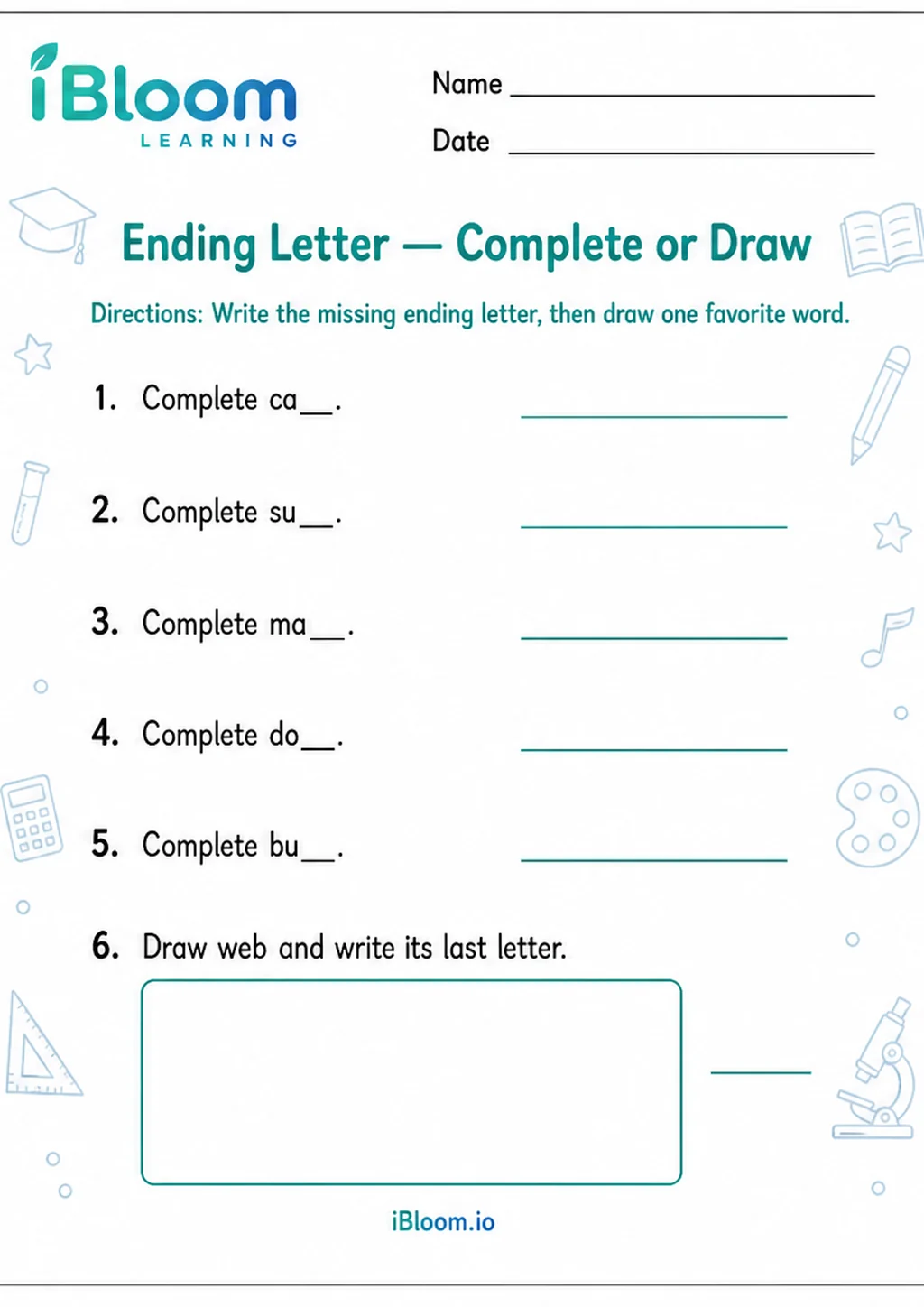


About this worksheet
This free preschool and kindergarten worksheet puts ending consonants into familiar sentences about pets, home and everyday objects. An adult reads each sentence, and the child says its capitalized picture word before circling one of two letters. Twelve questions use cat, sun, map, dog, bus, cup, pig, hat, bed, hen, crab and bat. The pictures help establish the word, while the sentences give it a familiar use. Parts A and B each contain six questions. The practice connects consonant sounds to letters under Common Core RF.K.3a, and a separate answer key is included.
Aligned to RF.K.3a
How do the sentences make the words familiar?
Each sentence places a pictured word in an everyday action: a cat naps, a bus gives us a ride, and a cup holds a drink. An adult reads the sentence so the child can focus on saying the word and hearing its last sound.
The target word is in capitals. For “I sip from a CUP,” the child says cup, then chooses p. The child can point to the picture while saying the word.
How should we say a word to hear its ending?
Say the whole word naturally, then repeat it slowly enough to hear the final sound. Keep stop sounds short: the final /t/ in cat should not become a full extra syllable. Ask the child to repeat the word before looking at the letters.
- 1Read: The CAT naps on the soft blanket.
- 2Say the picture word: cat.
- 3Listen at the end: /t/.
- 4Circle t.
How can I review the twelve answers?
Check six words at a time. Part A uses cat, sun, map, dog, bus and cup; Part B adds pig, hat, bed, hen, crab and bat. The correct choice changes position, so children need to listen to every word.
For a missed item, say the target word again and compare the two letter sounds. Afterward, say cat and hat together and ask what sounds the same at the end.
How to use this worksheet
- 1Point to the first picture and read its sentence aloud.
- 2Say the capitalized word together and listen for the last sound.
- 3Name the two letter choices and let the child circle one.
- 4Complete Part A, take a short break if needed, then try Part B.
- 5Check the key and repeat any missed word without pointing to the answer first.
Mistakes to check together
The mistake
Choosing b for BED by listening to its beginning.
The fix
Say bed slowly and listen for /d/, the sound just before the word stops.
The mistake
Listening to naps instead of CAT in the first sentence.
The fix
Read the sentence, then say only the capitalized word before choosing.
The mistake
Choosing t for CRAB without saying the whole word.
The fix
Say crab, then repeat its final /b/ sound briefly and choose b.
Common Core alignment
Connect the last consonant sound in each picture word to its letter.
On this sheet: Children say familiar picture words and select the letter for each final consonant sound.
Show the official wordingHide the official wording
Demonstrate basic knowledge of one-to-one letter-sound correspondences by producing the primary sound or many of the most frequent sounds for each consonant.
What to practice next
Make more practice
Further reading
Questions parents and teachers ask
Does my child need to read the sentences independently?
No, an adult can read every sentence aloud. The child’s job is to say the capitalized picture word and match its final consonant sound to a letter. Point to the picture while naming it, then give the child time to repeat the word before choosing between the two letters.
Which ending letters appear on this worksheet?
The answers use t, n, p, g, s, d and b. Several sounds appear in more than one word: cat, hat and bat end with t, while map and cup end with p. The crab adds a final b, giving children another ending sound to identify.
What if my child uses a different name for a picture?
Use the capitalized word as the shared name for this task. For example, say hen when the sentence says HEN, even if your child first says chicken. Both names may make sense in conversation. Repeat the target word, then listen together for its final sound before choosing a letter.
Should children circle the letter or color the picture?
Children circle one letter beside each question. The picture helps them identify the word, and the sentence gives it a familiar setting. Ask the child to say the capitalized word aloud before circling. There are twelve questions, each with two choices and one correct ending letter.
How can I use the answer key without giving away answers?
Keep the separate key aside until your child has tried a part. For a missed item, reread the sentence and repeat the target word together before checking the key. Ask the child to say the final sound, name its letter and circle that letter on the worksheet.