

About this worksheet
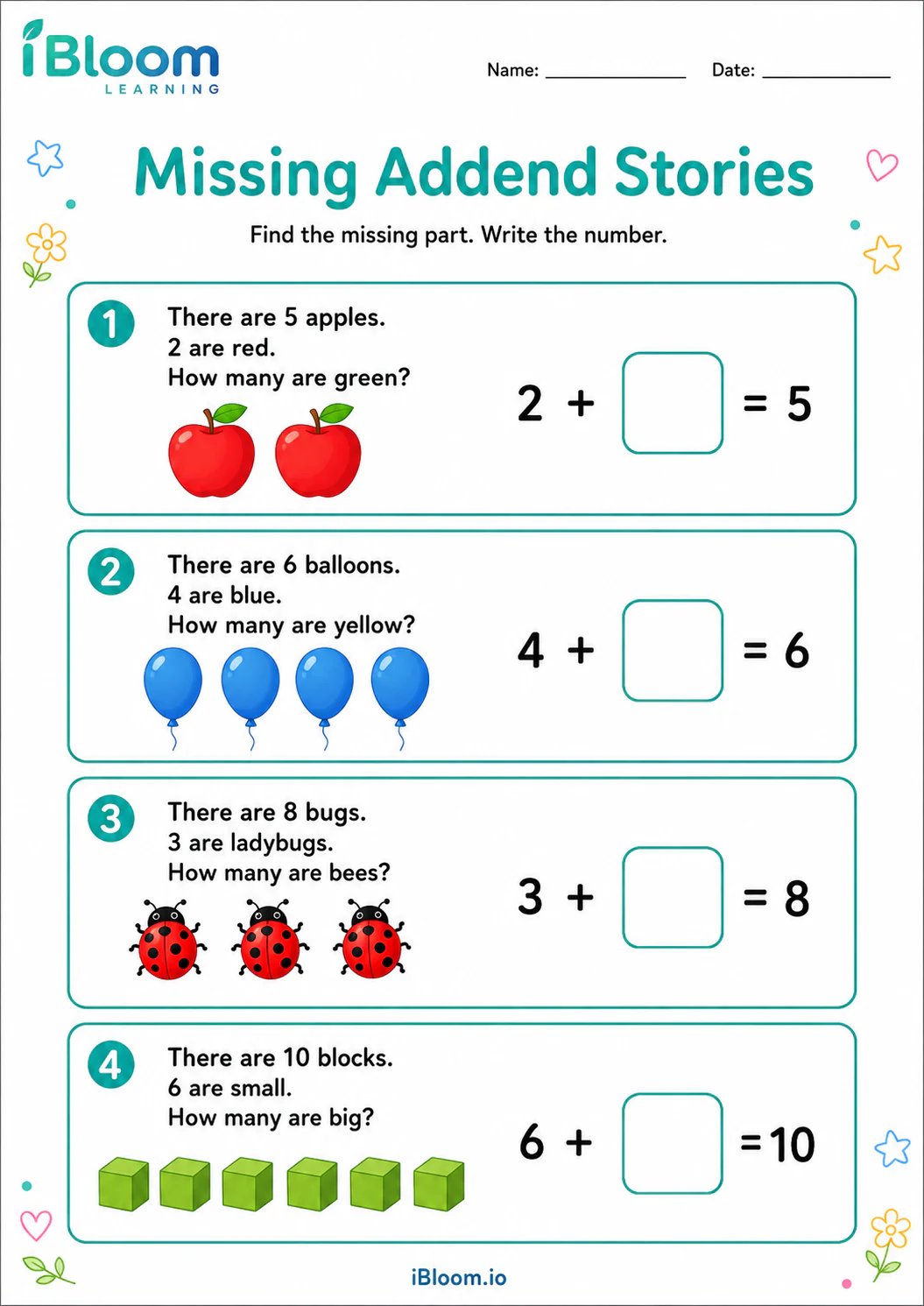
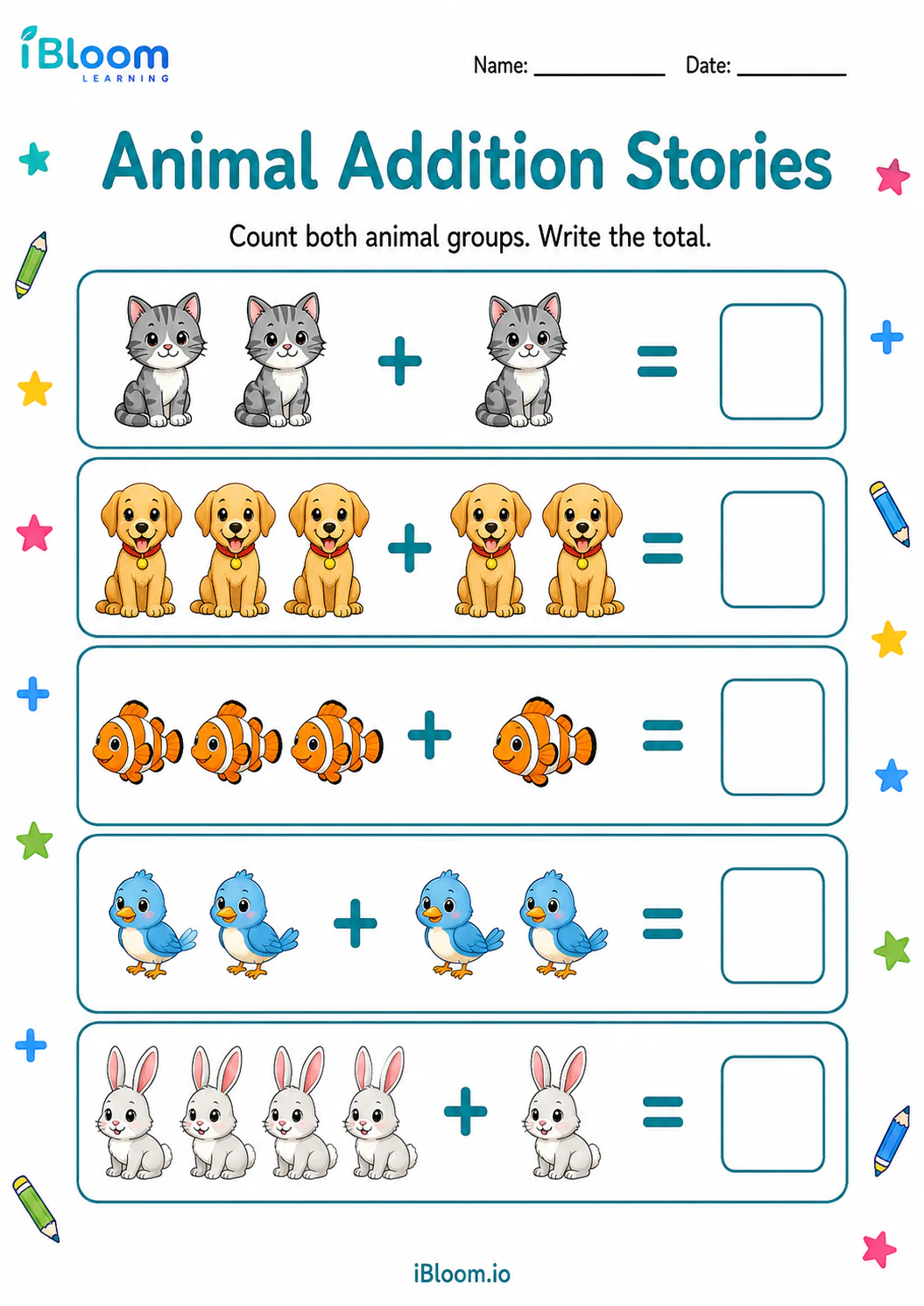
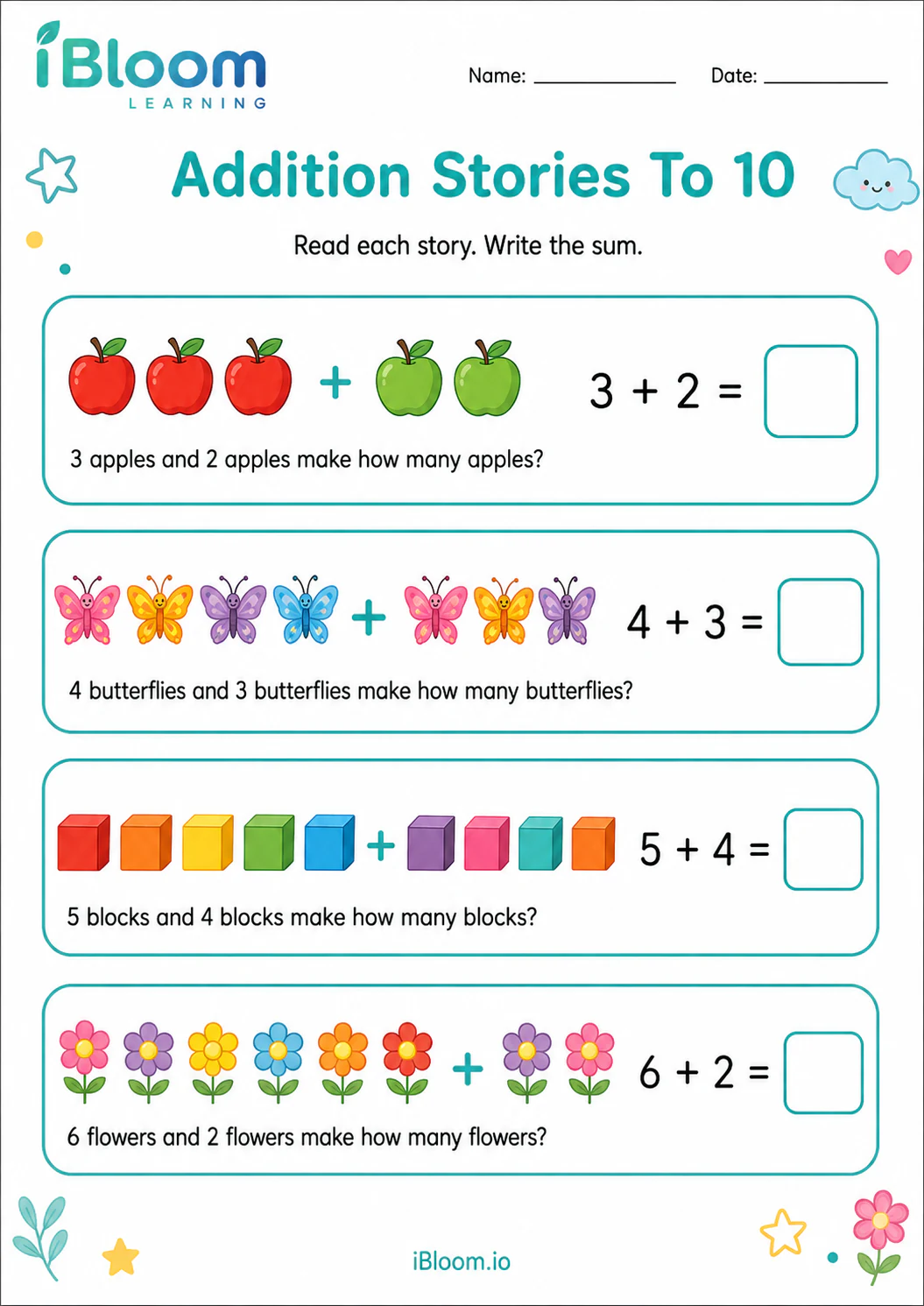
This free kindergarten worksheet asks children to find the missing part in an addition sentence. Part A shows groups of apples with totals of four, five, or six. Part B uses ten frames to help children find the number that makes ten. All 15 questions keep the missing number inside the addition expression so children practice reading an equation as two parts making one total. The sheet supports Common Core K.OA.A.3 and K.OA.A.4. A separate key shows every missing addend.
Aligned to K.OA.A.3 and K.OA.A.4
How do the apple pictures help?
Each apple picture in Part A shows the total in the equation. Have the child touch the number of apples named in the known part, then count the remaining apples. The answer goes in the blank. The repeated totals show more than one way to break a number into two parts.
- 1Question 3: 2 + ___ = 5.
- 2There are five apples altogether.
- 3Touch two apples, then count the other three.
- 4Check: 2 + 3 = 5.
What do the filled and empty frame spaces mean?
Each ten frame in Part B has ten spaces. The counters show the known addend, and the empty spaces show how many more counters would make ten. Children can count the empty spaces directly or count on from the number of filled spaces.
In the final two equations, the blank comes first. The meaning stays the same: the missing part plus the filled part makes ten. Ask the child to read the equation aloud before writing the answer.
How can an adult support an unsure child?
Use small counters alongside the printed pictures. Build the total, move the known part to one side, and count the other part. Then read the finished equation aloud. This links the physical groups to the numbers and the plus and equal signs.
Keep the work untimed. If counting is slow, complete Part A first and return to the ten frames later. Check answers by joining the two parts, rather than asking the child to memorize a list of missing numbers.
A picture-to-equation routine
- 1Read the total after the equal sign.
- 2For Part A, count all the apples and touch the known part.
- 3Count the apples left for the missing part and write that number.
- 4For Part B, count the empty ten-frame spaces to find how many more make ten.
- 5Read every completed equation aloud and check that its two parts make the total.
Mistakes to notice and fix
The mistake
Writing 7 for 2 + ___ = 5 by adding the two printed numbers.
The fix
Five is the total. Separate two from a group of five to find the other part.
The mistake
Writing the number of filled counters in the blank.
The fix
The filled counters are already named. Count the empty spaces for the missing part.
The mistake
Treating a blank at the start as the total.
The fix
Point to the equal sign: the total is still ten. Read “something plus three equals ten.”
Curriculum alignment
Use apple pictures to split totals into two parts in different ways.
On this sheet: Part A presents each of the totals four, five, and six with two different known parts.
Show the official wordingHide the official wording
Decompose numbers less than or equal to 10 into pairs in more than one way, e.g., by using objects or drawings, and record each decomposition by a drawing or equation (e.g., 5 = 2 + 3 and 5 = 4 + 1).
Find the missing part that makes ten using counters in a ten frame.
On this sheet: Part B records complements to ten in missing-addend equations.
Show the official wordingHide the official wording
For any number from 1 to 9, find the number that makes 10 when added to the given number, e.g., by using objects or drawings, and record the answer with a drawing or equation.
What to practice next
Make more practice
Further reading
Questions parents and teachers ask
What is a missing addend?
A missing addend is one of the parts being added. In 2 + ___ = 5, the total is five and the known part is two. The child finds three for the blank because two and three together make five. The worksheet supplies pictures to support that reasoning.
Do the apple pictures show the answer or the total?
The apple pictures show the total. Children use the known addend to separate that total into two parts. For example, five apples go with 2 + ___ = 5. After touching two apples, the child counts the other three and writes three in the blank.
Should my child draw more counters in the ten frames?
Children may add counters or pencil dots to the empty spaces if that helps them see the missing part. They should also write the number in the equation’s blank. Counting empty spaces without drawing is equally useful; the key checks the missing number that makes ten.
Why do some equations have the blank first?
The first-position blanks help children see that either addend can be missing. In ___ + 3 = 10, the filled counters represent three, and seven more are needed. Read the sentence aloud and check seven plus three together, just as you would check three plus seven.
Is this suitable for a short home practice session?
Yes. The 15 questions can be split into six apple-picture questions and nine ten-frame questions. Work through one part at a time if your child needs a break. Keep a few counters nearby, let the child explain one answer aloud, and use the separate key to check the numbers.