



About this worksheet
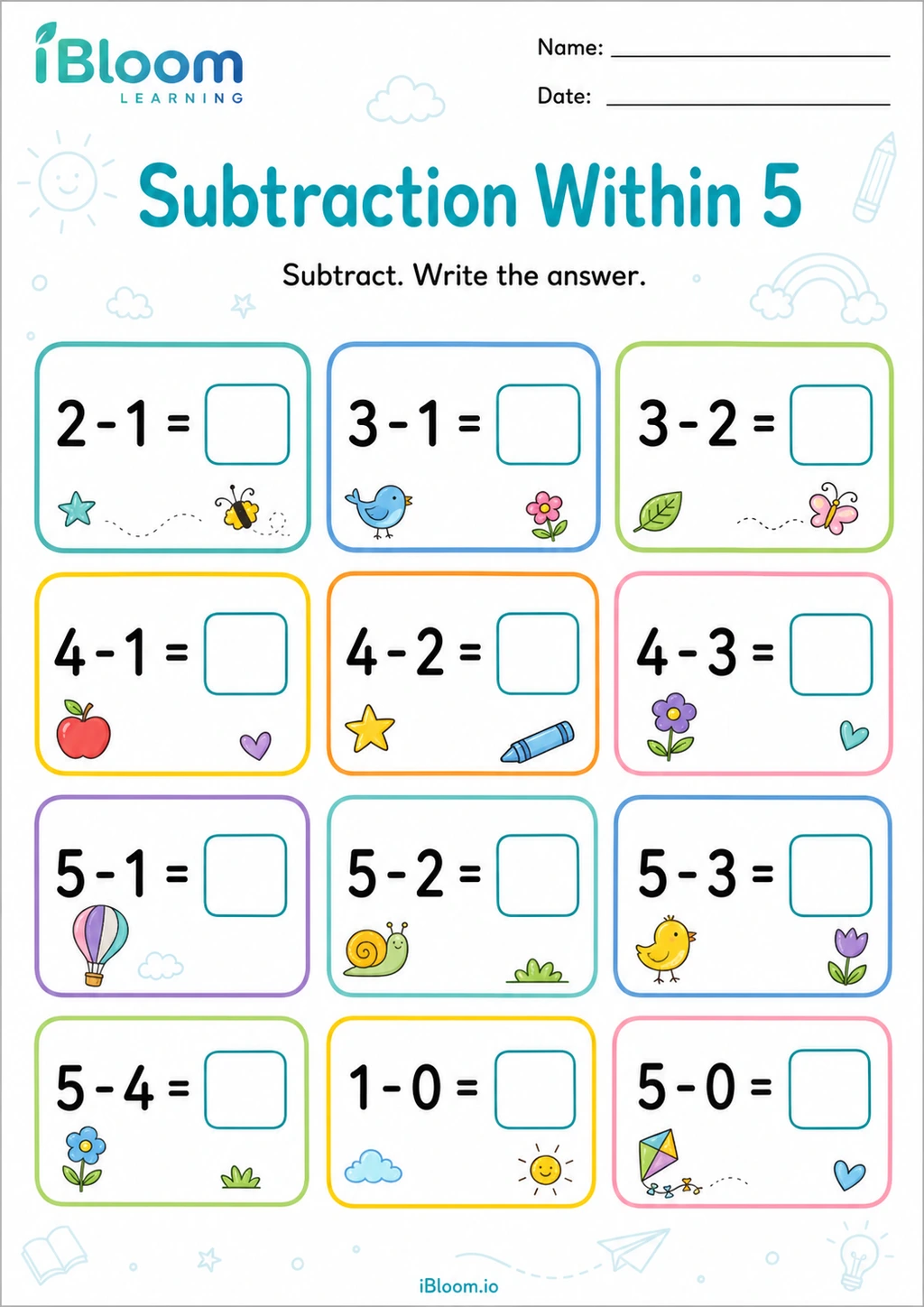
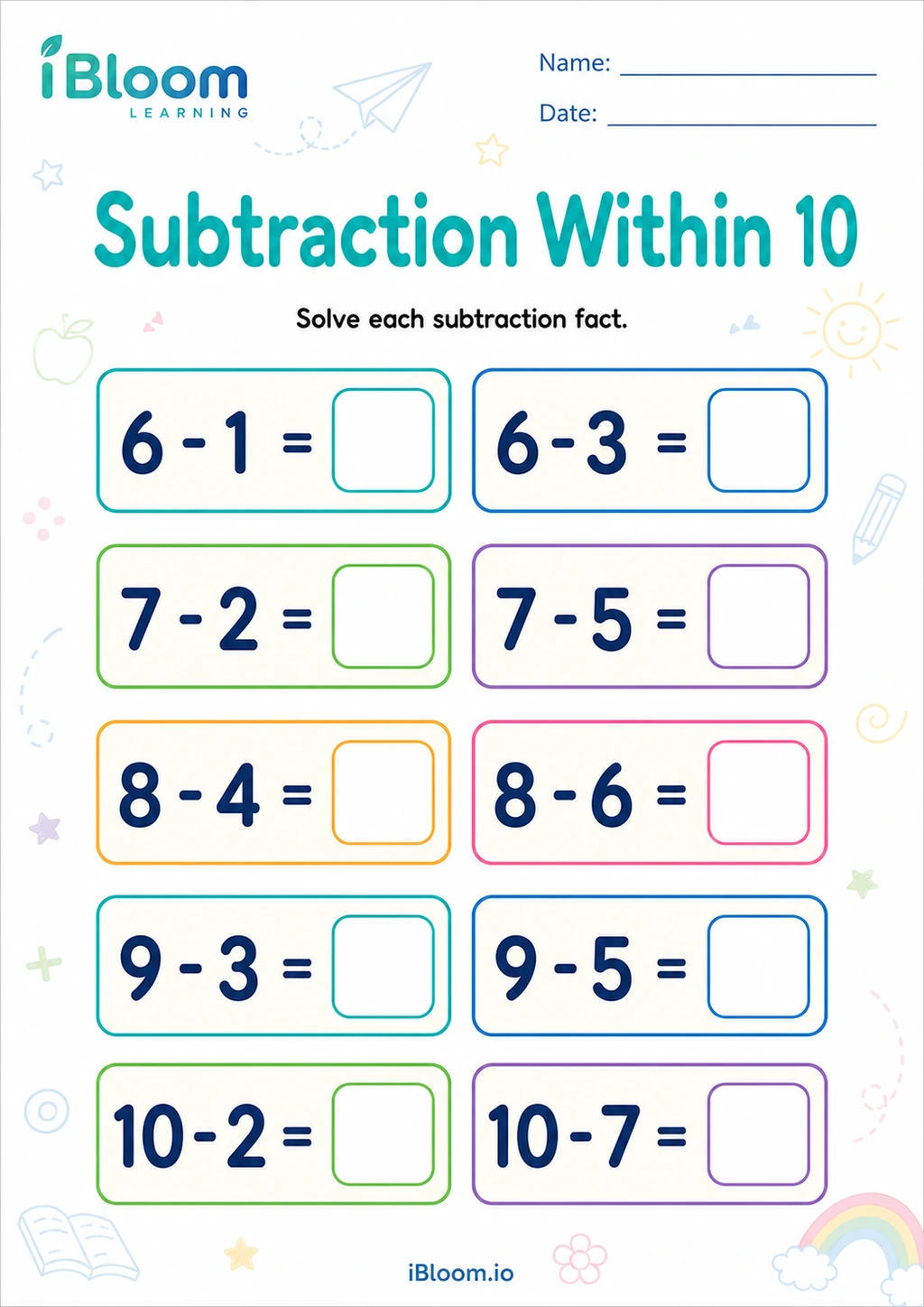
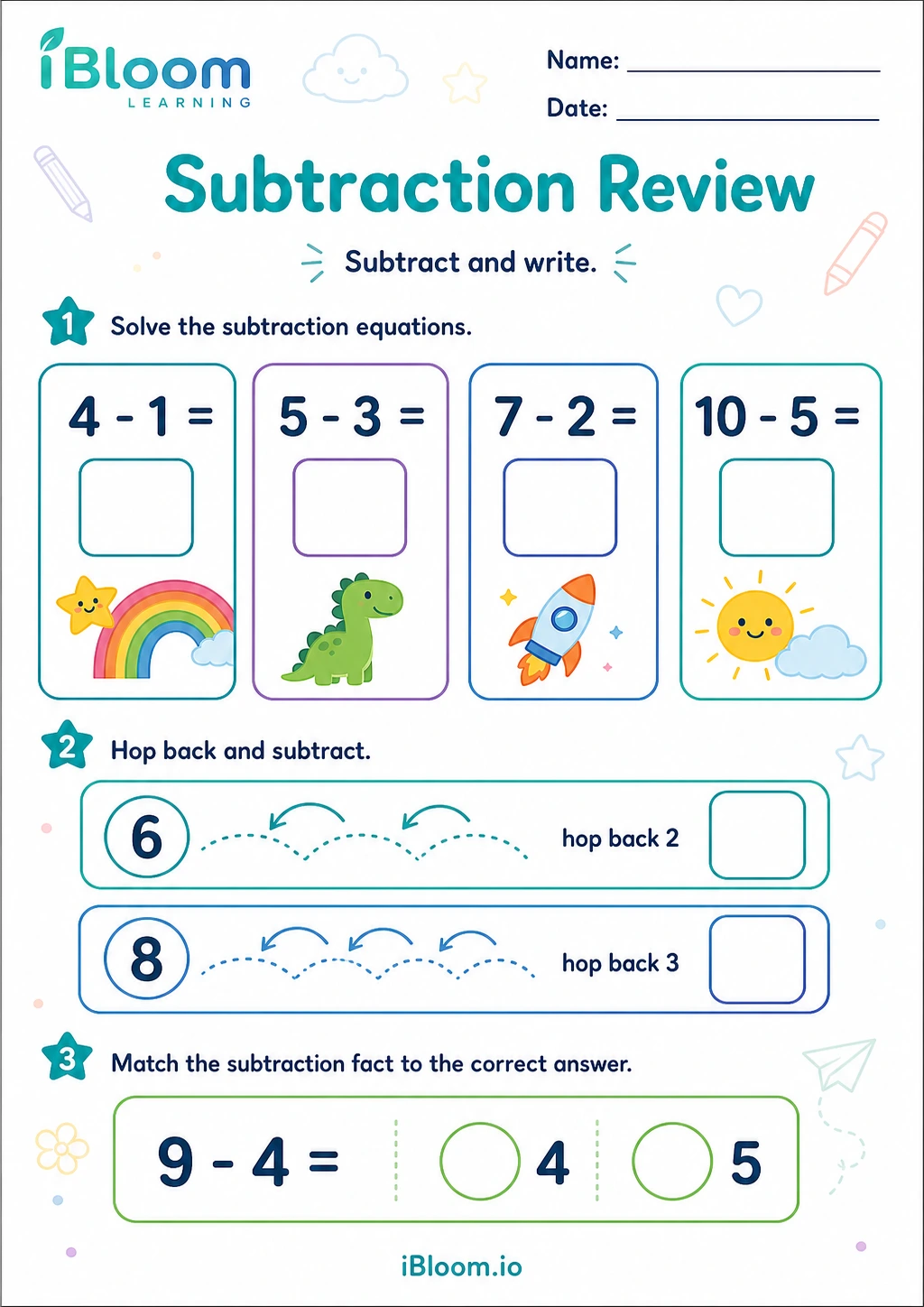
This kindergarten printable shows subtraction as taking counters away from a group. Children cross out the number being subtracted in each ten frame, then count what remains. Sixteen facts stay within 10 and move from smaller groups to frames filled to ten. The answer key gives a quick way to check each result.
Aligned to K.OA.A.1
How does a ten frame show subtraction?
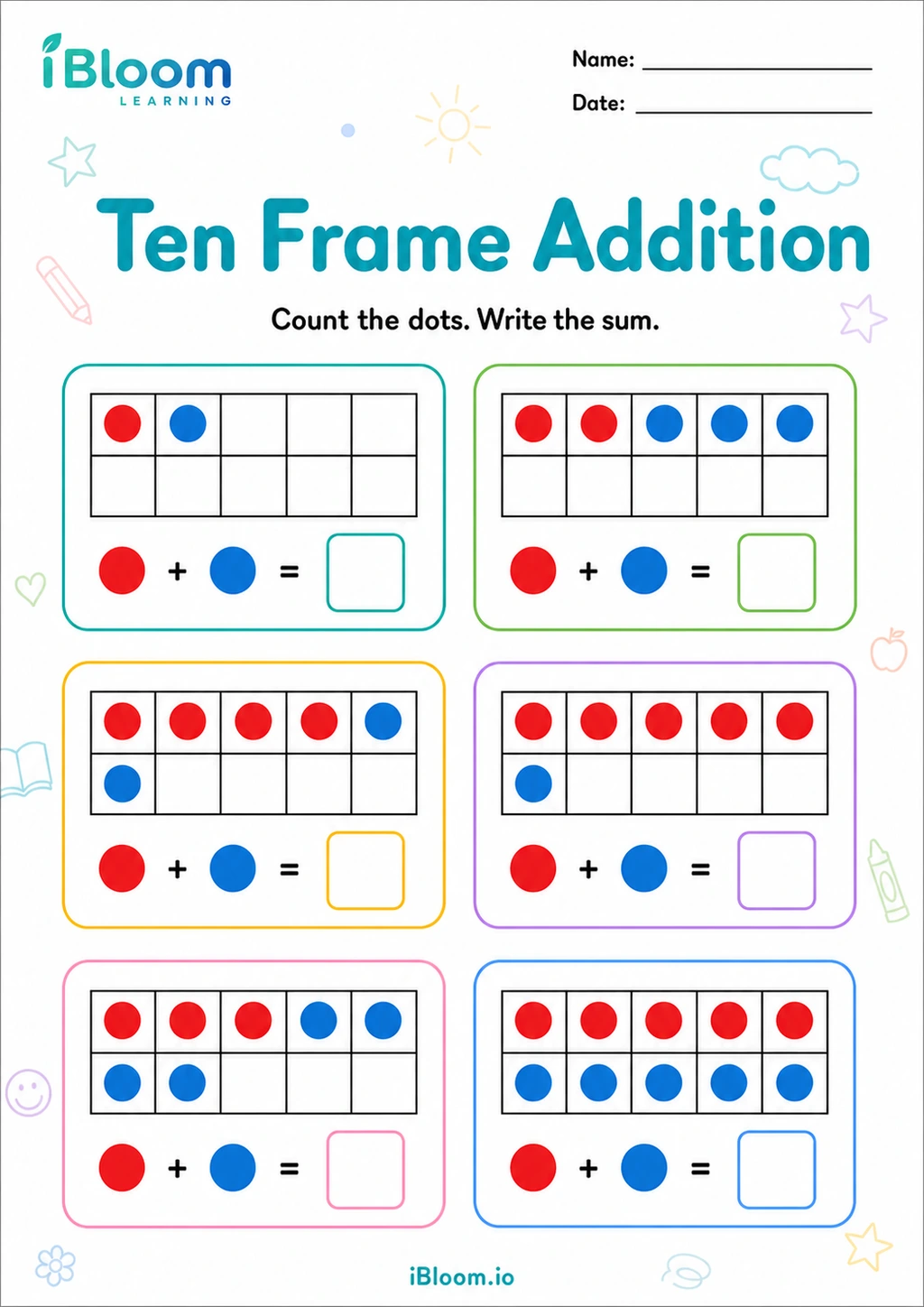
A ten frame arranges counters in two rows of five. Cross out the number being taken away, then count only the counters that remain.
For example, in 5 − 1, cross out one of the five counters. Four counters remain, so 5 − 1 = 4.
What will children practice?
The worksheet has 16 subtraction facts, each paired with a ten-frame drawing. Part A starts with groups from five to ten; Part B gives eight more facts to solve with the same take-away strategy.
- Cross out the counters being subtracted.
- Count the uncrossed counters to find the difference.
- Check all 16 answers with the separate key.
How to use the worksheet
- 1Point to the full set of counters and say the starting number aloud.
- 2Read the subtraction sentence and cross out that many counters.
- 3Count the counters that are still visible, then write the answer.
- 4Ask the child to explain how the drawing matches the number sentence.
- 5Use the answer key after the child has completed the page.
Common subtraction mix-ups
The mistake
Counting the crossed-out counters as the answer.
The fix
Count only the counters that are still visible.
The mistake
Subtracting the starting group from the take-away number.
The fix
Read the equation left to right: start with the first number, then take some away.
The mistake
Skipping a counter while counting what remains.
The fix
Touch each uncrossed counter once as you count.
Common Core alignment
Model subtraction with ten-frame counters and connect the drawing to an equation.
On this sheet: Children cross out counters in a ten frame and count the remaining objects to solve each subtraction equation.
Show the official wordingHide the official wording
Represent addition and subtraction with objects, fingers, mental images, drawings, sounds (e.g., claps), acting out situations, verbal explanations, expressions, or equations.
What to practice next
Make more practice
Further reading
Questions parents and teachers ask
How do children use the ten frames?
The counters show the starting number in each subtraction fact. Children cross out the number being taken away and count the counters left in the frame. For 5 − 1, one counter is crossed out and four remain. The drawing makes each subtraction amount visible.
Are all of the answers within 10?
Yes. All 16 facts begin with a number from 5 to 10, and each take-away amount is smaller than the starting group. Children can count the uncrossed counters to find a difference from 1 to 8. The key lists each result.
Should I show a child how to cross out counters?
Model one problem by naming the starting amount, crossing out the take-away amount, and counting what remains. Then let the child try the next frame. Pointing to the counters one at a time helps prevent skipping or counting a crossed-out counter.
Does the printable include an answer key?
Yes. The separate answer key shows the answers for all 16 subtraction problems. Have the child finish the worksheet before checking. If an answer does not match, return to that ten frame, cross out the take-away group, and count the visible counters together.
What does K.OA.A.1 mean here?
K.OA.A.1 asks students to represent addition and subtraction with objects, drawings, actions, and equations. Each problem pairs a subtraction equation with a ten-frame drawing. Children model the take-away action and connect the counters that remain to the answer.